
 Maya Reed
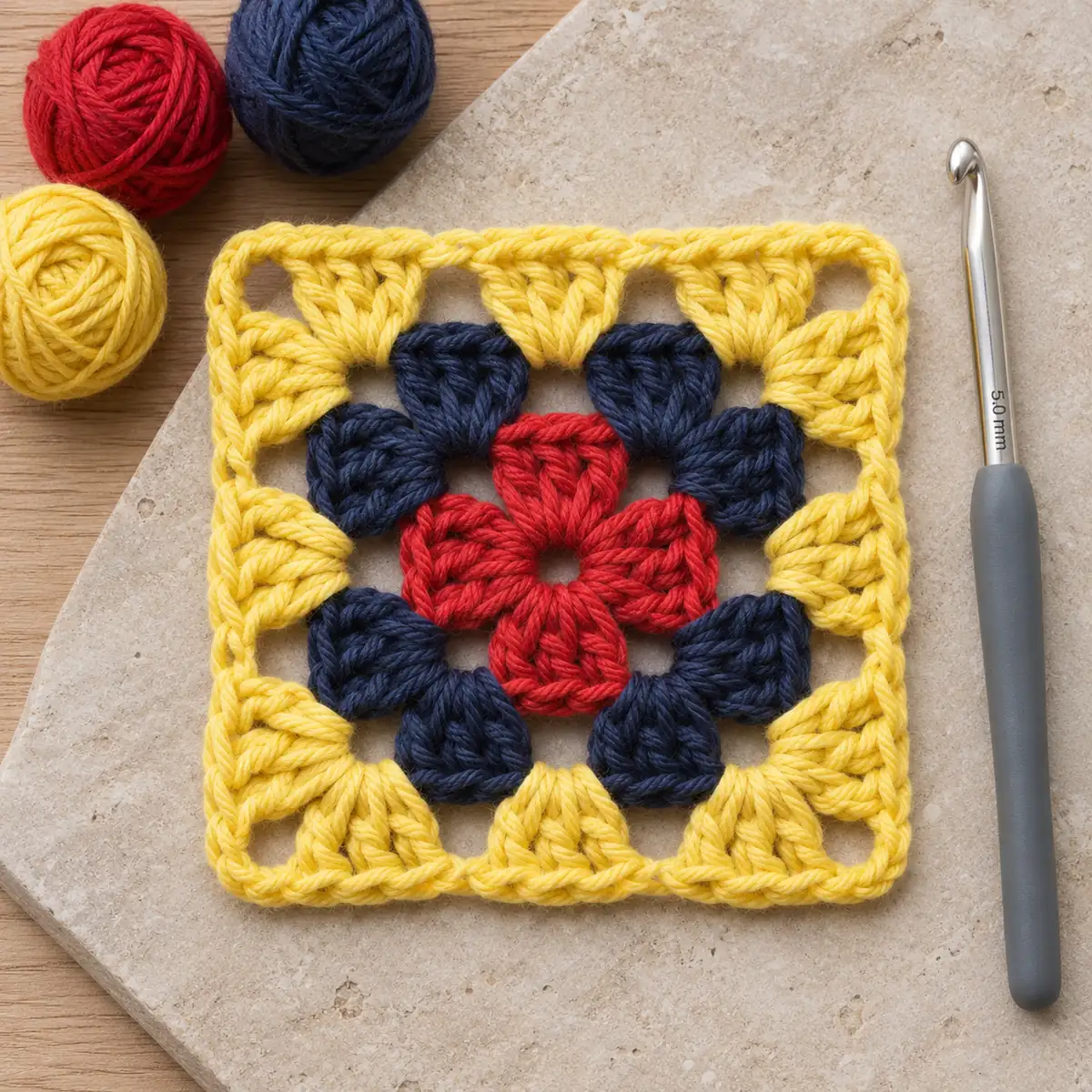
The classic granny square is a useful study in how a small repeated unit builds a larger fabric. Three double crochet stitches share a space, chain openings separate the groups, and four corner spaces keep the direction changes organised. The motif grows without turning every old stitch top into a new insertion point. This article follows the original pattern and keeps its separate yarn, hook and corner-chain versions distinct. The aim is to understand what the group and space system does before comparing a three-round sample with a larger square. The source example uses medium-weight yarn and a 5 mm hook.
Read the structure · Materials and terminology · Complete source instructions · Measurements and variants · Inspect the fabric
Two kinds of space control the growth
A group is three separate double crochet stitches in one opening. It is not three stitches closed together into one cluster. In the main version, the corner opening contains two chains and a side opening contains one. Each corner receives two groups, while each ordinary side space receives one. The different placement, rather than a different kind of double crochet, makes the motif turn.
Look at one side from corner to corner. Include the group contributed by each neighbouring corner when counting groups along that side. After the second round there are two; after the third there are three. The count is about the groups lying along an edge, not the number of empty openings you see between them. That distinction becomes useful when the square is large enough that the centre no longer fills your view.
The instructions below include several source versions. Do not combine the four-round version’s three-chain corners with the main version’s measurement table and assume the result is identical. Material, hook and corner choices belong to their own stated examples. Reading those associations is part of understanding the fabric, especially when two versions happen to use the same number of groups.
Set up a sample you can actually compare
Choose scarlet for A, midnight navy for B and clear lemon for C in the three-colour example. Each yarn ball is one solid colour. Keep the yarns similar in weight so that a much thinner or thicker round does not obscure the structural comparison. The source does not require this particular palette. It is a way to distinguish the first three rounds while examining how their groups relate.
For the workspace, use a pale stone sample board beside an ash-wood surface, with the yarn labels and hook kept at the edge. The board provides a clear background for viewing the open spaces. Record the thread and hook for any sample you make. A photograph alone cannot establish the exact size or feel of the finished fabric.
Materials and stitches
For the example, use medium-weight yarn with a 5 mm hook. Match the hook to your yarn. For motifs of equal size, use yarns of similar weight. You also need scissors and a yarn needle. US terms: ch = chain; sl st = slip stitch; dc = double crochet. A three-stitch group consists of 3 separate dc worked into the same space.
Ring and round1
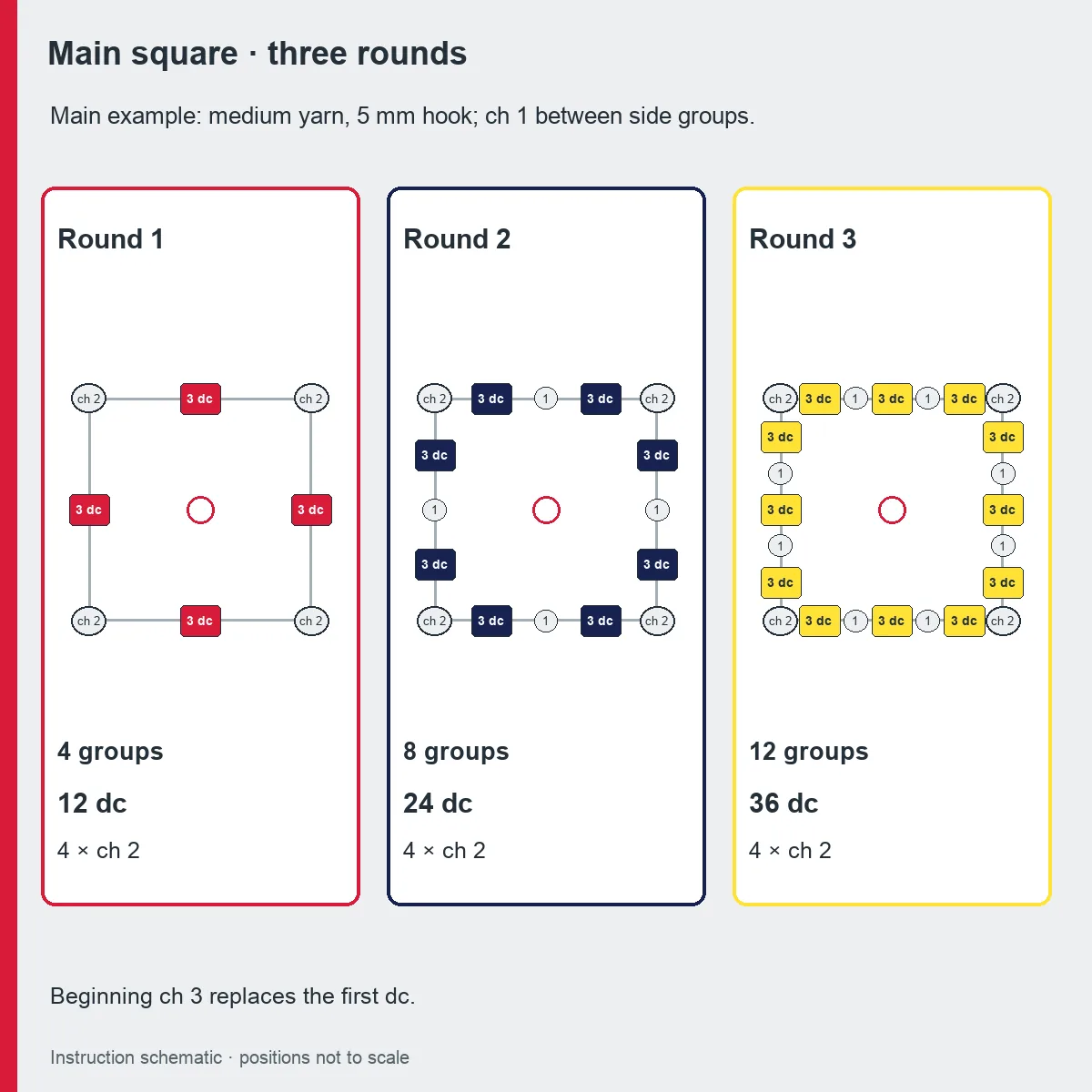
With colour A, ch 4 and join with 1 sl st to form a ring. Ch 3 to count as the first dc, then work 2 more dc into the ring. Ch 2. Repeat 3 times:3 dc and ch 2 into the ring. Join with 1 sl st into the third starting chain. You have 4 three-stitch groups and 4 corner spaces. Cut the yarn, leaving a tail for weaving in.
Corners and sides from round2
Join colour B in any corner. Work ch 3,2 dc,ch 2 and 3 dc into the same space. Ch 1 to the next corner space. In each remaining corner work 3 dc,ch 2,3 dc. Work ch 1 between corners, including before the closing slip stitch. Join into the third starting chain. Each side now has 2 groups with a ch 1 space between them.
Join colour C in a corner space. Work the corners as in round 2. Work 3 dc into every ch 1 space of the previous round. Work ch 1 between neighbouring groups along the sides. Join the round with a slip stitch. After round 3, count 3 groups per side, including the groups belonging to the two adjacent corners.
Repeat round 3 in your chosen colour. Work only into the spaces of the previous round. The number of groups per side increases by one each round. At the end, check that there are 4 ch 2 spaces and that all sides have the same number of groups.
Size and finishing
With 5 mm and medium-weight yarn, the source gives approximately 10 cm after 3 rounds,15 cm after 5 rounds,20 cm after 7 rounds,25 cm after 9 rounds and 30 cm after 11 rounds. Measure the side length with the square lying flat. For a set of motifs, use the measurement of your own sample. Weave in ends within matching colour areas and arrange the square flat after washing.
Continuing in one colour
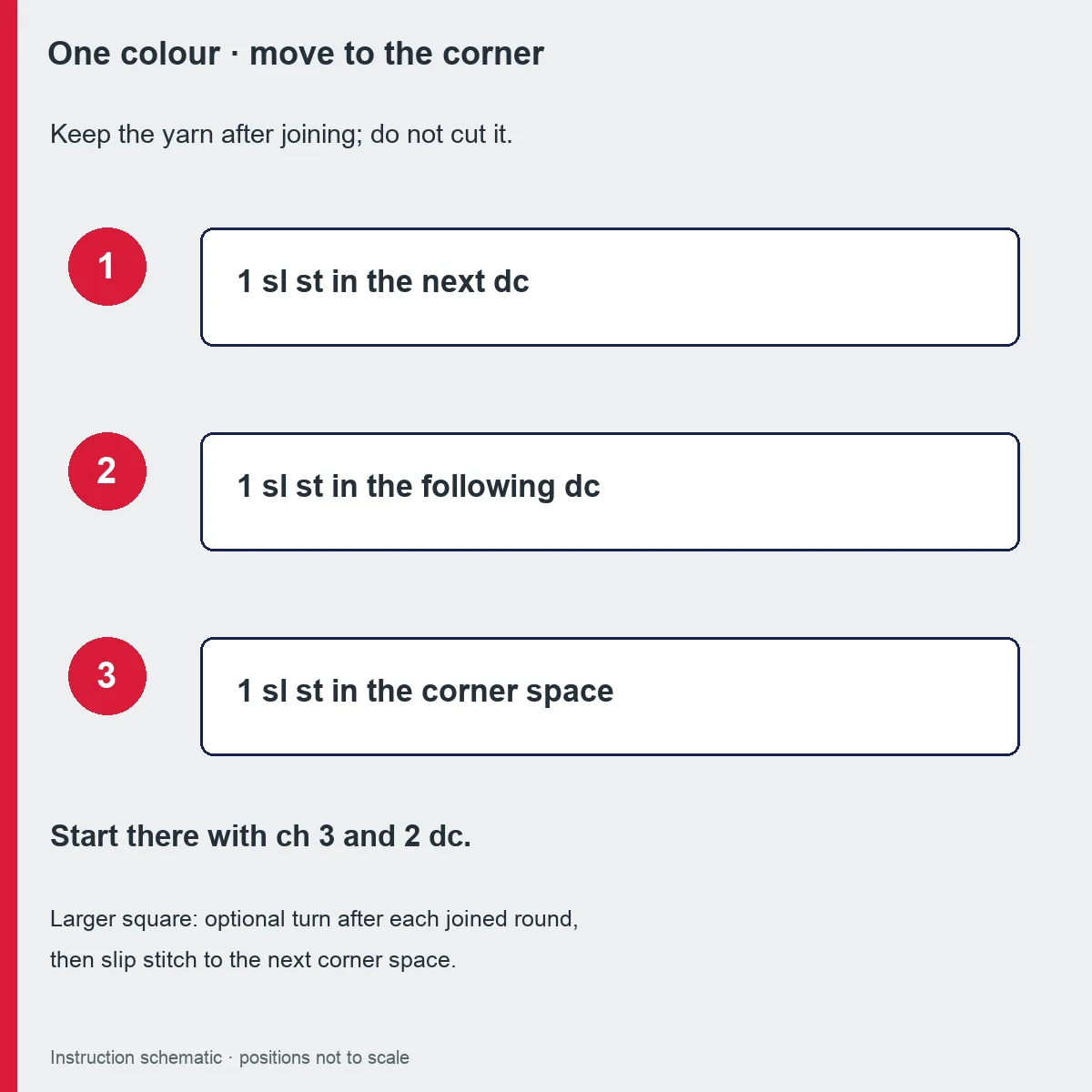
For a single-colour square in light-coloured cotton yarn with a 5 mm hook, do not cut the yarn after joining the round. Work 1 sl st into each of the next two double crochets and 1 further sl st into the corner space. Begin the next round there with ch 3 and 2 dc. Continue with ch 2 in each corner and ch 1 between groups along the sides.
For a larger square, you may turn after each joined round to reduce twisting at the centre. After turning, slip stitch to the next corner space and begin the next round there.
Four rounds with larger corner spaces
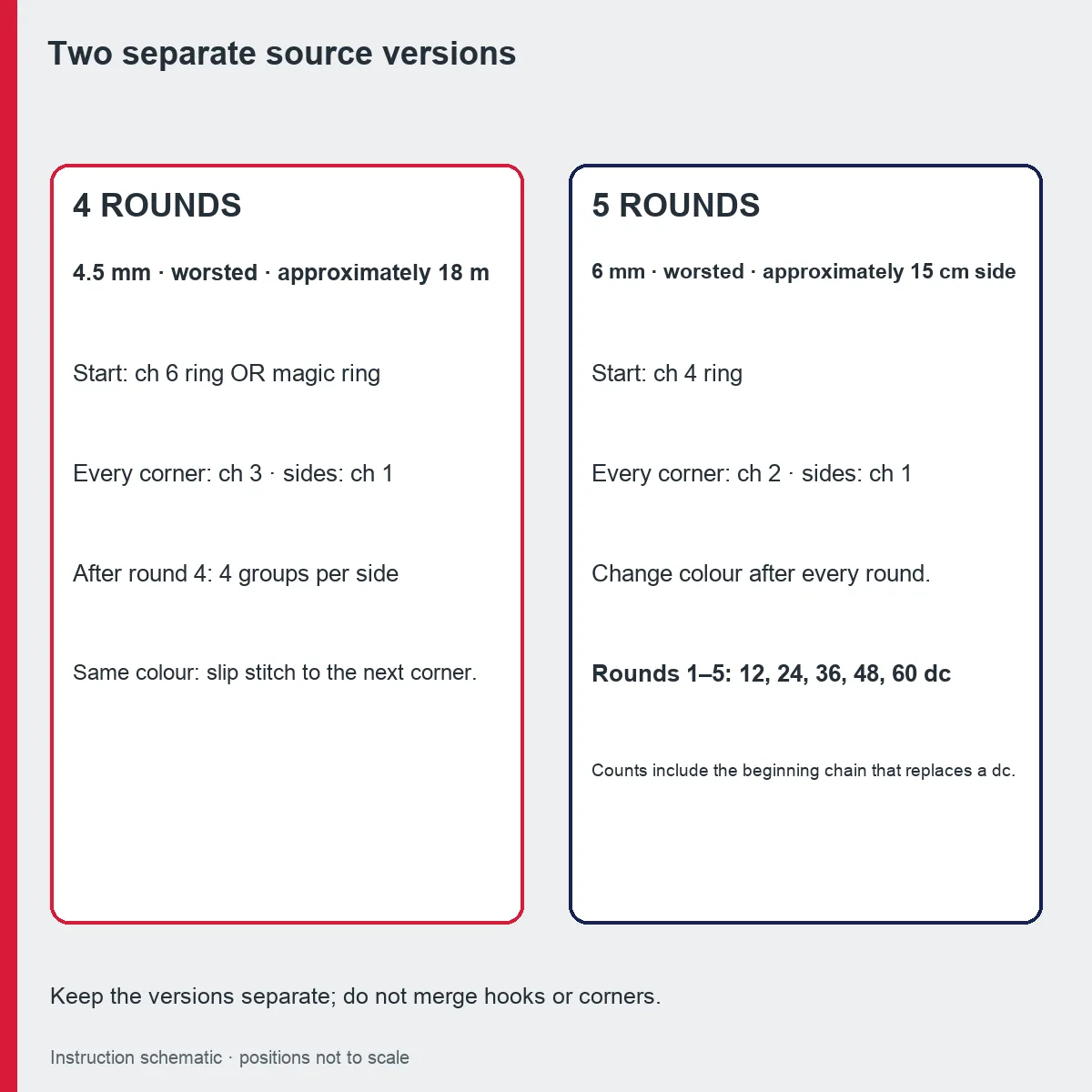
For this version, you need approximately 18 m of worsted yarn and a 4.5 mm hook. Start with ch 6 joined into a ring, or use a magic ring. Work the 4 three-stitch groups of round 1 with ch 3 between them. In rounds 2 through 4, also use ch 3 at every corner. Keep ch 1 between groups along the sides.
If continuing in the same colour, slip stitch to the next corner space after joining the round. After round 4, count 4 three-stitch groups per side. Cut the yarn and weave in the ends.
Five rounds with a6mm hook
With worsted yarn and a 6 mm hook, the five-round version measures approximately 15 cm along each side. Start with ch 4 joined into a ring and follow the classic instructions with ch 2 in each corner and ch 1 between side groups. Change colour after every round.
Including the starting chain that replaces a double crochet, rounds 1 through 5 contain 12,24,36,48 and 60 dc respectively. From round 3 onward, when changing colour, the first group still begins with ch 3 and 2 dc.
Adjusting corner spaces to the yarn
For a tighter corner, you may work ch 1 instead of ch 2 in every corner throughout all rounds. With thick yarn, you may also use ch 2 or ch 3 for the corner. When using only ch 1, mark the 4 corner spaces because they are then the same length as the side spaces. Work 2 three-stitch groups into every corner and one into each side space. The starting chain always replaces the first double crochet of the first group.
Inspect positions rather than just the total count
A side appears to have an extra group
First find the four corner spaces. Then follow one side between them, including the corner groups that border it. If you counted a corner twice or mistook a side opening for a corner, the apparent total can change without an extra stitch having been made. Recount from a marked corner before undoing the work. The main pattern’s corner has a longer chain than its side space, which helps identify it.
When using the source’s optional one-chain corners, that visual difference disappears. The source specifically tells you to mark the four corners. Treat the markers as a way to preserve the role of each opening, not as permission to put a corner group into any opening of the same length. Identical chain lengths can still have different jobs in the fabric.
The centre seems to twist as the square grows
The source allows turning after each joined round for a larger single-colour square, followed by slip stitches to the next corner. Keep that option connected with its stated instructions. Compare the relaxed square before and after the optional turning method. Observe your own square and preserve the original corner and side counts if you use the source-permitted approach.
The beginning group looks unlike its neighbours
The ch 3 replaces the first double crochet. Together with the two worked double crochet stitches, it forms a complete three-stitch group. Fine or smooth yarn can make the replacement chain look narrower than the posts beside it. Do not add a fourth element simply to make three identical posts visible. The chain’s role belongs in the count.
Compare choices without merging their instructions
Corner-chain length changes the opening, not the group rule
The source offers one, two or three corner chains in specified circumstances. Each corner still receives two groups, and each ordinary side opening receives one. Keep the chosen corner length consistent through the version you are working. A single longer corner inserted halfway through a round changes the spacing of that point and is not the same as adopting a consistent source variation.
The four-round version uses a 4.5 mm hook, approximately 18 m of worsted yarn and three chains in every corner. The five-round example uses a 6 mm hook and two-chain corners. Those are separate material and construction references. A side measuring approximately fifteen centimetres in the five-round example does not establish the size of a four-round square made with another hook.
The side measurement belongs to a flat finished sample
Lay the square flat when comparing a side with the source’s approximate table. A diagonal is a different measurement. Do not pull the fabric until a chosen number appears, and do not use an unfinished round to predict a large assembly without checking the completed sample. The source itself directs you to use the measurement of your own motif for a set.
No precise making time or fixed quantity is supplied for the main version. The approximately eighteen-metre amount belongs to the separate four-round example. Recording the actual material you use is more informative than transferring that quantity to every square on this page. The same care applies to the fifteen-centimetre estimate: it is associated with a specific five-round example, not a universal rule.
From a fabric study to a different scale
The miniature granny square earrings show how groups, spaces and an added edge can be read at a much smaller scale. They use their own fine thread, hook and corner instructions. Compare the construction ideas without replacing this pattern’s two-chain main corners with the jewellery pattern’s different corner treatment.
For available projects, browse the Crochet Craft Lab pattern collection. The Maya Reed author page explains the site’s approach to understanding crochet fabric. Compare the stitches and openings of each square, then measure the relaxed sample made with your chosen yarn.