
 Maya Reed
This textured crochet blanket puts three different stitch heights into one insertion point. The group is easy to recognise once you separate its shape from its counting role: it contains three stitches, but supplies one double-crochet anchor for the next row. This guide examines that relationship while keeping the complete source method and all six foundation sizes. Use worsted category 4 yarn and the source's 5.5 mm hook. The quoted widths describe a relaxed starting chain, not a guaranteed finished blanket width. Make and measure a sample before choosing a dimension-sensitive project.
Materials and six size references · Complete rows · Source border · Read the group structure
Choose the yarn and blanket size
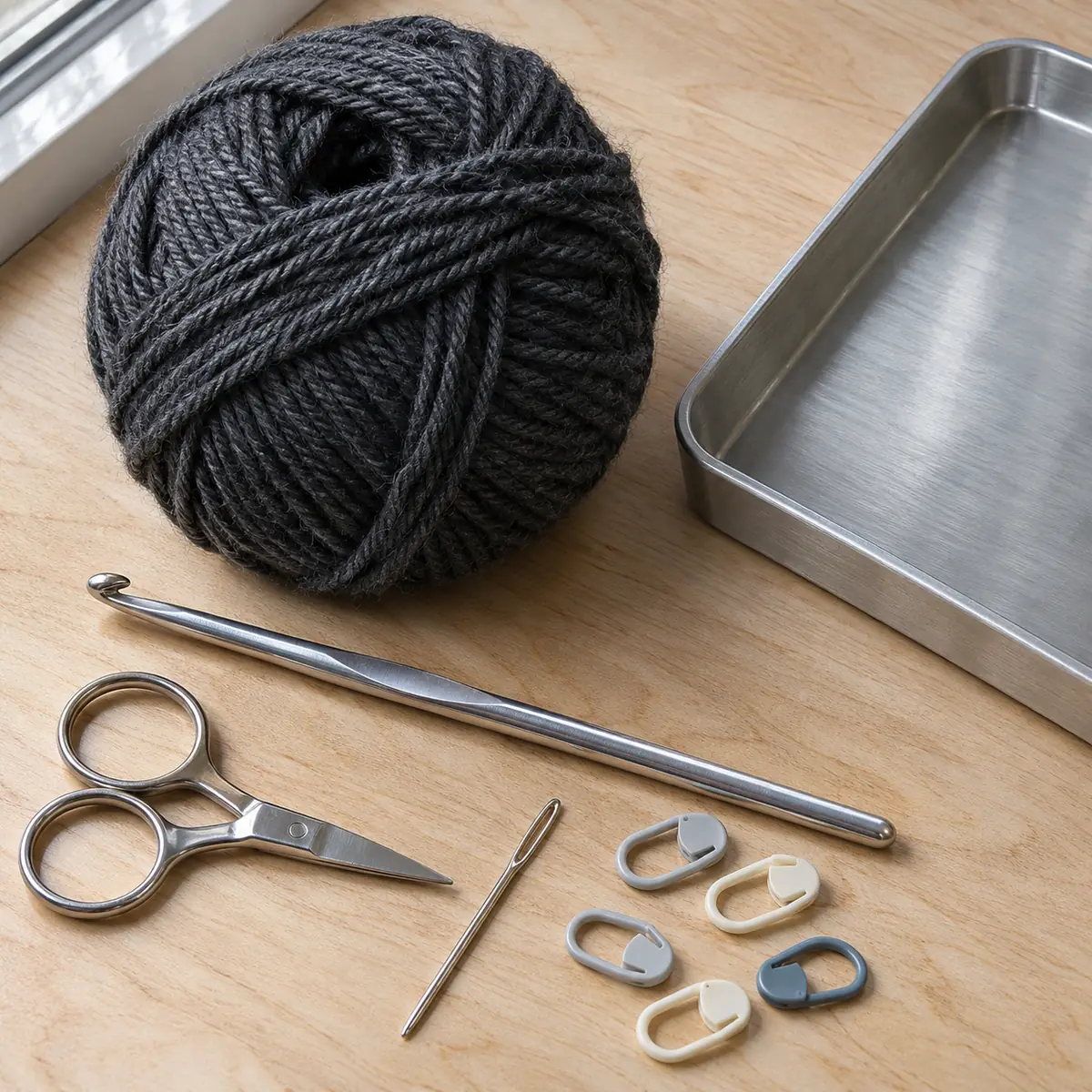
You need worsted yarn, category 4, a 5.5 mm crochet hook, scissors and a yarn needle. This pattern uses US crochet terminology: ch means chain, sc means single crochet, hdc means half double crochet, dc means double crochet and sl st means slip stitch. The repeated group contains one sc, one hdc and one dc, all worked in the same insertion point. The different heights create the textured surface.
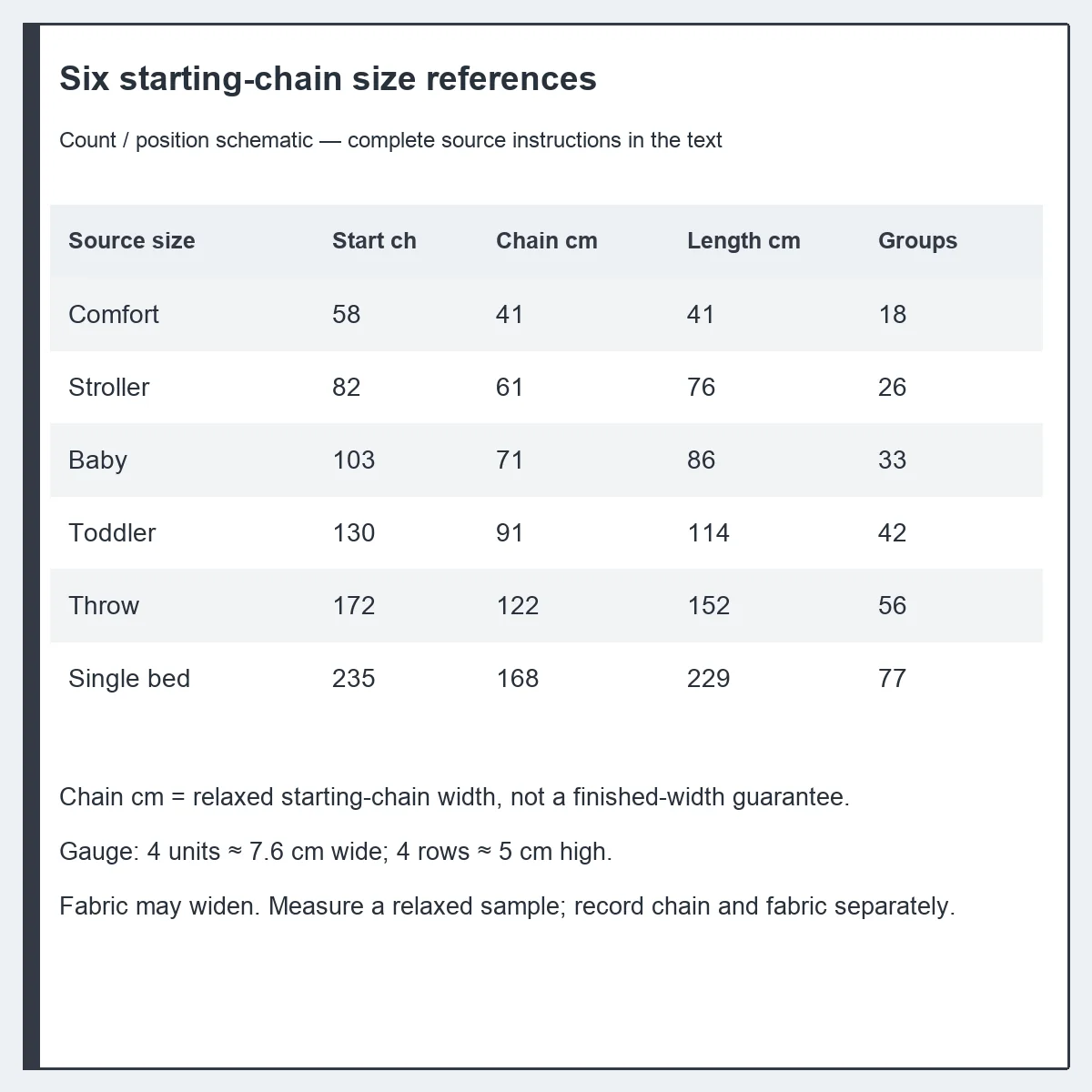
| Size | Foundation chains | Chain width × target length, approximately |
|---|---|---|
| Comfort square | 58 | 41 × 41 cm |
| Stroller blanket | 82 | 61 × 76 cm |
| Baby blanket | 103 | 71 × 86 cm |
| Toddler blanket | 130 | 91 × 114 cm |
| Throw | 172 | 122 × 152 cm |
| Single-bed blanket | 235 | 168 × 229 cm |
The width refers to the loosely laid-out foundation chain. The fabric may widen a little after several rows. For another width, make a multiple of 3 plus 1 chain. The source states that 4 pattern units are approximately 7.6 cm wide and 4 rows are approximately 5 cm high. If dimensions matter, crochet a sample first and measure it without stretching.
Understand the three heights as one repeat
Each group places a single crochet, a half double crochet and a double crochet into the same target. Those different heights create the small raised shapes. Do not translate “one group” into “one stitch” when examining the top edge: the three separate stitch heads still exist. In the repeating row, only the double crochet of the previous group receives the complete new group. The other two stitch heads remain unworked. This is deliberate placement, not a decrease that must be balanced somewhere else.
A plain solid charcoal yarn is an optional way to make a restrained sample; use good light so the darkest stitches remain readable. The source does not prescribe a colour or fibre. Keep the actual yarn label with the sample, including its care information. A change in fibre, twist or surface finish can alter how easily those three heads can be recognised. Choose for the material in hand rather than assuming the printed yarn category guarantees an identical surface or measurement.
Distinguish an anchor from a stitch total
After the first row, each group contributes one potential double-crochet anchor to the next row. There are also two edge half double crochets, one at either side. If you count every top loop as a group, the apparent number will be much too high. If you count only the double crochets, keep the edge stitches outside that group count. Naming the item being counted is the simplest way to avoid comparing a foundation-chain total with a group total as if they were the same unit.
Map the foundation from the fourth chain
The first group enters the fourth chain from the hook. Subsequent groups advance by three chain positions because two chains are skipped before the next target. This creates a useful index sequence: fourth, seventh, tenth and so on. The final group is not worked in the final foundation chain. Two chains remain after that group before the final edge half double crochet is placed in the last chain. Keep that ending visible when checking the foundation instead of stopping the count at the last raised group.
For the 103-chain baby option, the source explicitly gives thirty-three groups, ending in the hundredth chain, followed by the final edge in the last chain. The three skipped chains at the beginning count together as the other edge half double crochet. They are not three additional edge stitches. Marking the first group and the final edge can help you see the two different boundaries without changing the pattern. Remove or move a marker only after identifying its actual stitch role.
Use the table without turning it into a finished-width promise
The foundation references and the gauge statement describe different observations. The table pairs a loosely laid-out chain width with a target length. The gauge gives the width of four pattern units and the height of four rows. Do not replace the table's chain reference with a calculated fabric width, or relabel it as a guaranteed finished dimension. The source warns that the fabric can widen after several rows. Your relaxed sample provides evidence for the yarn and tension actually being used.
Record the chain measurement separately from the fabric measurement after several complete rows. Label each clearly in a sample notebook. If those measurements differ, do not shorten a listed foundation silently to make a printed number reappear. Either use a source size with its stated starting chain or plan an explicitly separate custom width using the source multiple. Keep that choice visible so it does not become confused with the original six-size table.
Work the first pattern row
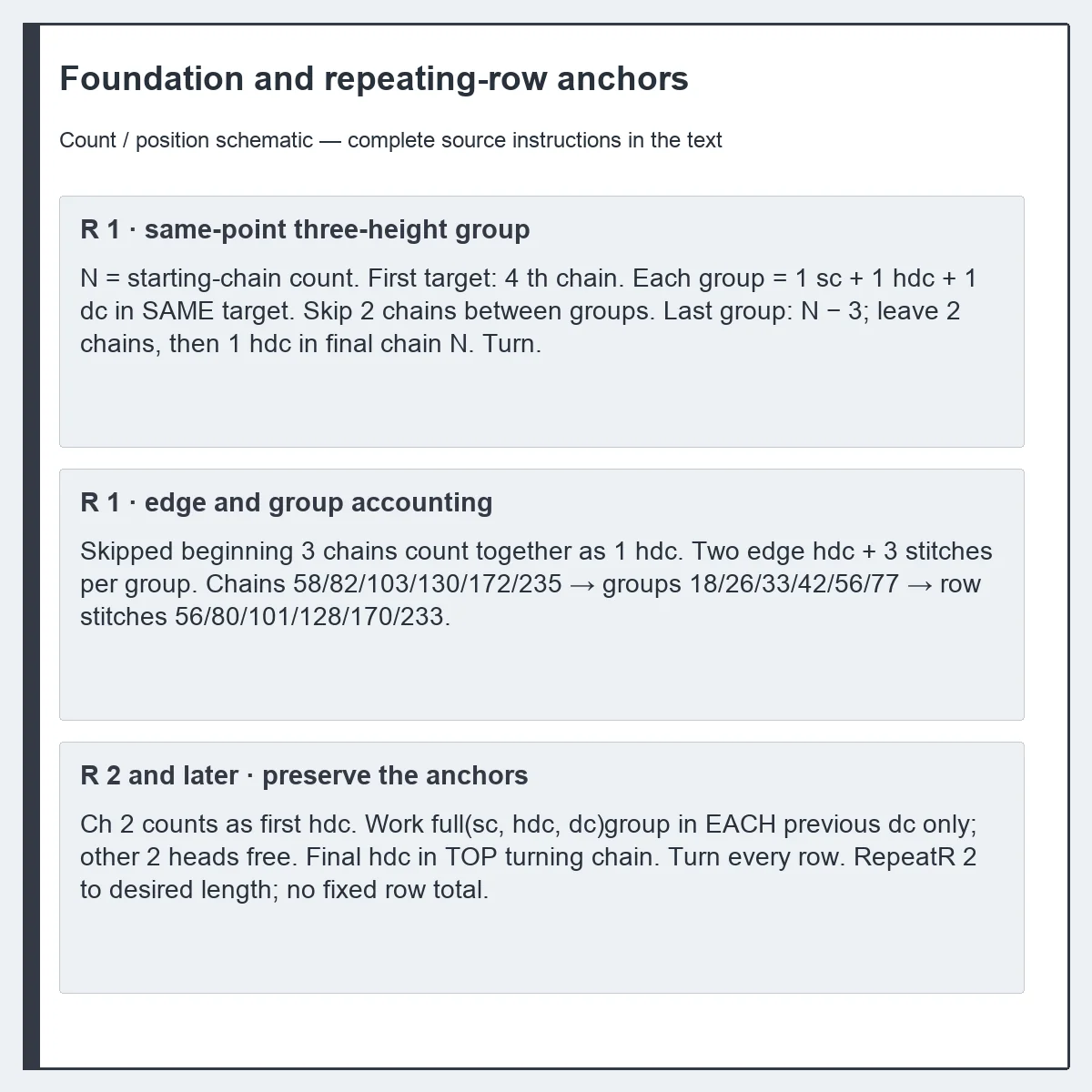
Loosely chain the number specified for your selected size. With the right side facing, work 1 sc, 1 hdc and 1 dc into the fourth chain from the hook. The 3 skipped beginning chains count together as 1 hdc. Skip 2 chains and work the next three-stitch group into the following chain. Repeat this across. After the final group, leave the next two chains unworked and work 1 hdc into the last chain. Turn.
With 103 foundation chains, you obtain 33 three-stitch groups and 1 hdc at each edge. The groups sit in the fourth, seventh, tenth and every following third chain up to the hundredth. Use this to check the foundation before beginning the second row.
Repeat the textured row
Ch 2 to count as the first hdc. Work 1 sc, 1 hdc and 1 dc together into the next dc, then into every following dc of the previous row. Leave the other two stitches of each group unworked. Finish the row with 1 hdc into the top turning chain of the previous row and turn.
Repeat this second row until the desired length is reached. Occasionally check the number of groups. If the edge becomes narrower, first check whether the finishing hdc has been omitted.
Add the single crochet border
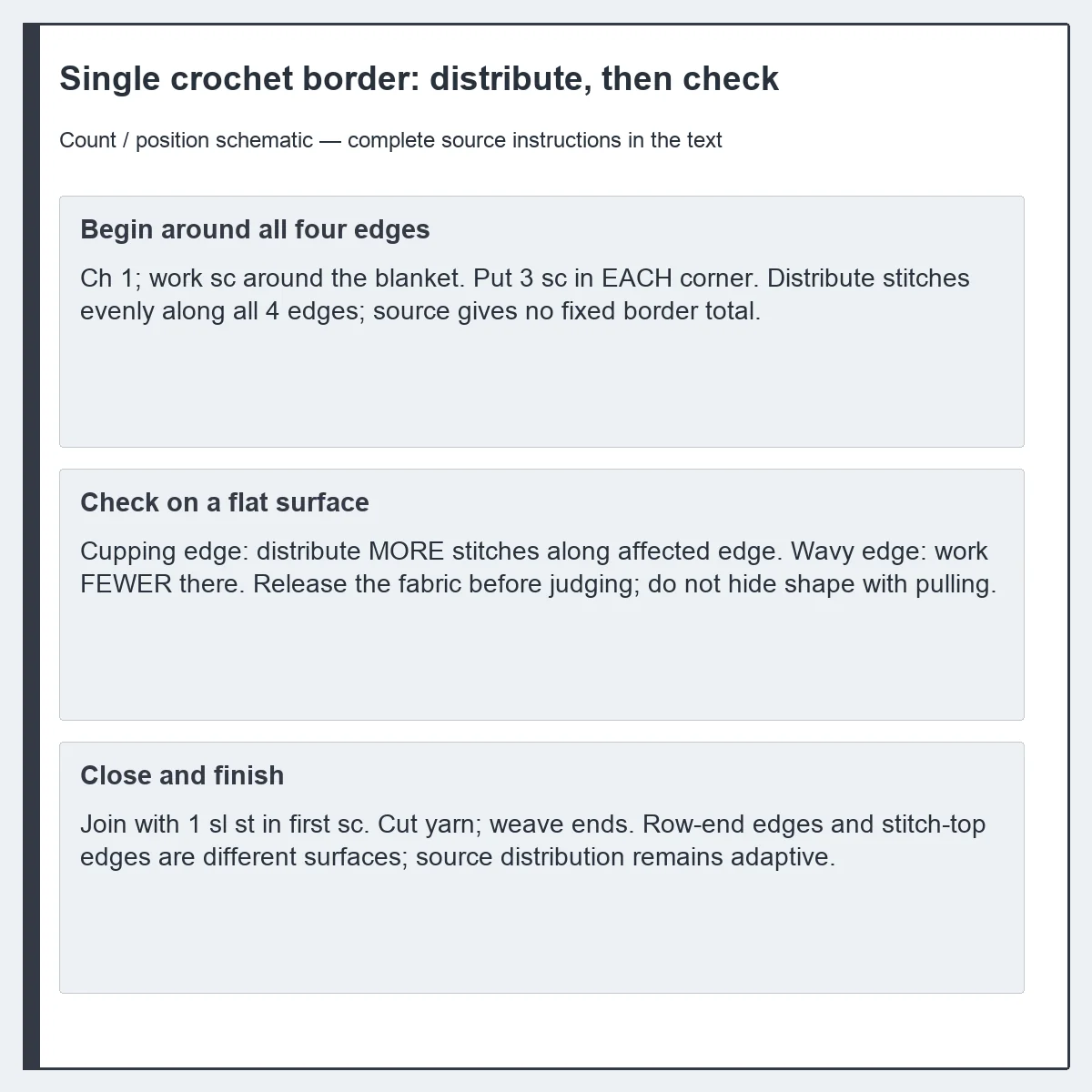
Ch 1 and work sc around the entire blanket. Work 3 sc into every corner and distribute the stitches evenly along the 4 edges. Lay the blanket flat occasionally. If the edge cups, distribute a few more stitches along the affected edge. If the edge becomes wavy, work fewer stitches there. Close the round with 1 sl st in the first sc, cut the yarn and weave in the ends.
Inspect the repeating row by its destinations
Turn the work exactly as instructed. The visible double-crochet head of the previous row is the next group's destination, while the beginning chain replaces the first edge half double crochet. Before working another group, identify the target rather than inserting into whichever stitch seems closest to the hook. The differing heights make the top edge less uniform than an all-double-crochet row. That uneven appearance is a reason to read the heads carefully, not a reason to add a stitch to level them.
At the far edge, the last half double crochet belongs in the top turning chain of the previous row. An edge can gradually narrow if this final stitch is missed. Compare the number of groups and the presence of both edges independently. A missing edge stitch can be concealed visually by a raised group, yet it still changes the boundary of the fabric. Do not try to recover the lost width by adding a new group in the following row; locate the actual omission first.
Diagnose a structural mismatch before undoing rows
The texture looks dense but the group count changed
Count double-crochet anchors one group at a time and compare corresponding rows. Look for a group placed into the previous group's single crochet or half double crochet in addition to the intended double crochet. An extra insertion point can create an extra group even when every group itself contains the correct three stitches. Conversely, an untouched double crochet can signal a missed group. Trace where the count first changes, rather than measuring only the last row and guessing at a correction.
The foundation is shorter than the later fabric
The source explicitly allows some widening after the first rows. First separate that expected change from a genuine increase in groups. Confirm that group count remains stable and the edge stitches are present. Then measure the relaxed sample, without pulling it sideways. Do not use the listed starting-chain width as a template for stretching the later fabric. If a precise project width is essential, make that measurement decision before investing in the full length, while keeping the source's counts and measurement labels intact.
The border does not lie flat
The source border has an adaptive distribution along each edge rather than a fixed stitch total. Follow its three single crochets in every corner and its instructions for a cupping or wavy edge. Check the blanket flat as you work. Counting every row end as though it always required the same number of border stitches would invent a rule absent from this source. Keep any sample-specific distribution in your own notes; do not present it as the universal border count for every size.
Compare structures with the right question
The eyelet-stripe square's stitches and spaces provides another example of counting different units separately. For a different anchor system, the Twinkling space map follows groups worked into openings. Neither supplies replacement rows for this blanket. Use the comparison to improve reading, then follow the blanket's own group destinations. Explore the pattern collection for other constructions and the author page for the editorial background.