
 Maya Reed
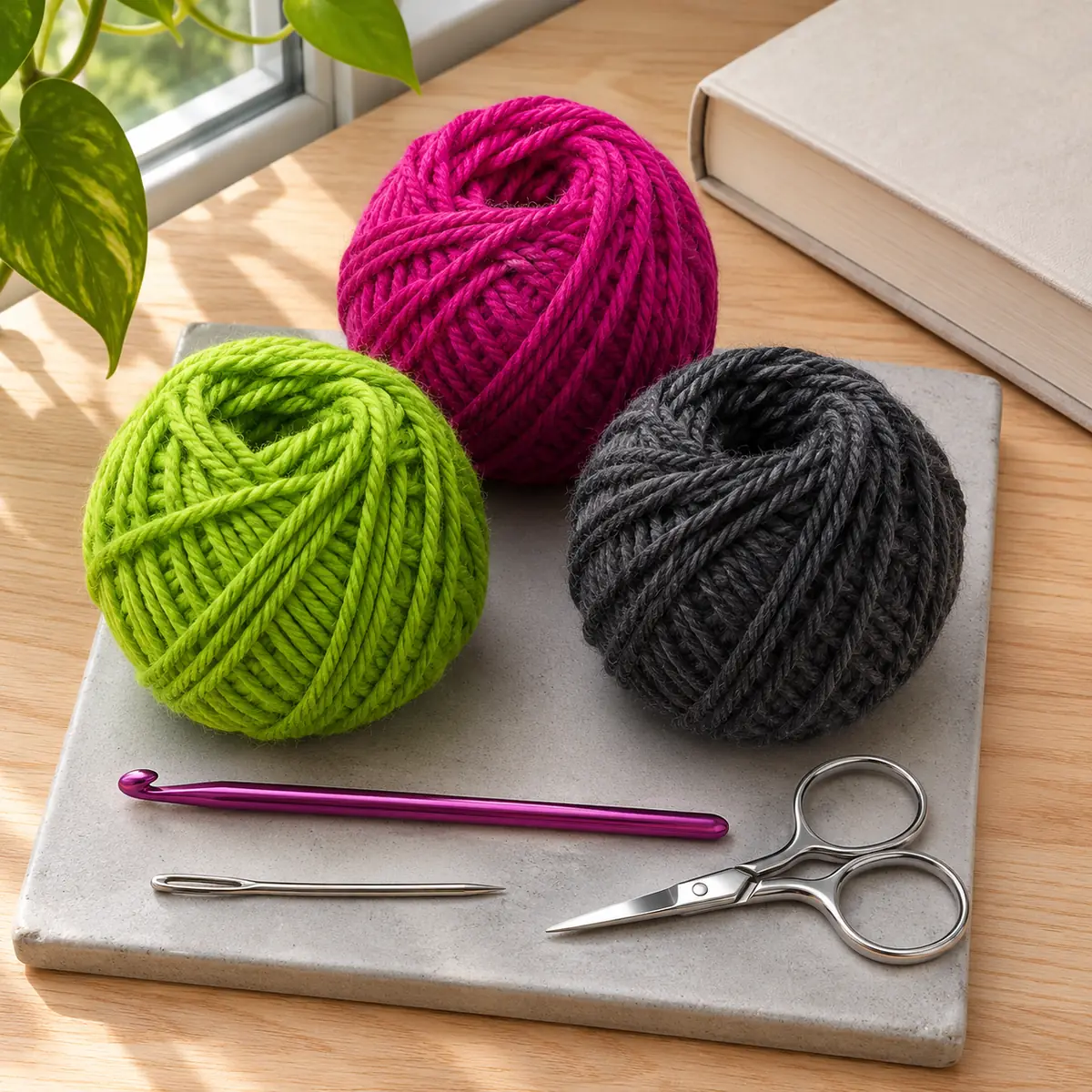
The flower bookmark combines three constructions on one narrow line: a leaf worked around a chain, a chain stem leading to a five-petal flower, and a separate round centre attached at the front. This guide maps the different working surfaces so the leaf's return side is not mistaken for a new row, and the centre is not mistaken for another flower round. All source counts and attachment options are retained. Three solid colours are needed; the example uses size 4 acrylic yarn. No numeric hook diameter or fixed finished dimensions are supplied.
Three colour roles · Complete source construction · Centre attachment paths · Trace the leaf and petals
Prepare three colours and the finishing tools
You need yarn in three colours: one for the leaf and stem, one for the petals and one for the flower centre. The example uses size 4 acrylic yarn. Choose a matching crochet hook and have scissors and a yarn needle ready. A hot glue gun may be used to attach the centre. The source does not prescribe a numeric hook diameter, a yarn quantity, fixed final dimensions or a gauge.
The chain stem can be adjusted to the spine length of a particular book, as the source allows. If you do not have a book in mind, its given starting reference is thirty-five chains. This is a stated adjustment, not permission to change the leaf or petal counts. Record the chain length chosen if you want to repeat the same bookmark for a similar book.
US crochet terminology
This article uses US terms. Ch means chain, sc single crochet, hdc half double crochet, dc double crochet, tr treble crochet and sl st slip stitch. The stitch called a German Doppelstäbchen is a US treble crochet. The loop on the hook is not an additional completed chain. Count the chain links below it when locating the second chain from the hook.
The leaf changes stitch height along each side of the starting chain. Its turn is not a new row across the same stitch tops; you rotate the leaf and work along the other side of the original chain. Identify that chain before continuing so the second side lies opposite the first rather than forming a separate strip on top of it.
Read the starting chain as the leaf's central spine
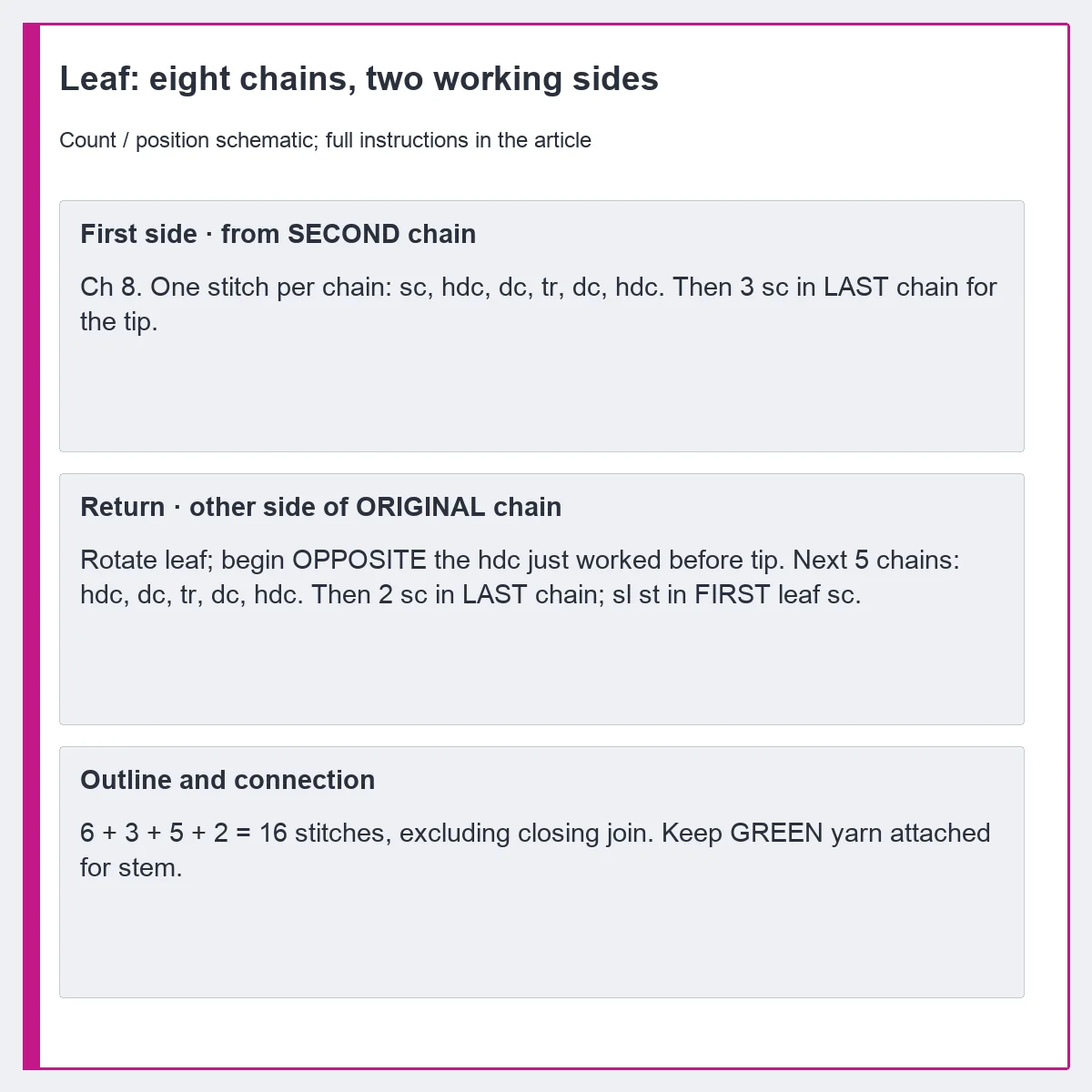
The leaf begins with eight chains. After the first is skipped, seven chain positions remain available along that side. Six receive individually named stitch heights; the final one receives the three single crochets at the tip. The height sequence is deliberate: single crochet, half double crochet, double crochet, treble crochet, double crochet, half double crochet. Reading only “tall stitches” would lose the rise and fall that defines the outline.
At the tip, rotate the leaf to reach the other side of the original chain. Do not turn back across the newly made stitch tops as though beginning an ordinary row. The return begins opposite the half double crochet just worked before the tip. Its five individual heights are half double crochet, double crochet, treble crochet, double crochet and half double crochet. The two final single crochets form the base before the closing slip stitch enters the leaf's first single crochet.
Sixteen stitches describe the outline, not the closing join
The first six heights and the three tip single crochets produce nine stitches. The five return heights and two base single crochets add seven. Together they give sixteen, with the closing slip stitch kept separate. This explains why the return list is shorter than the first-side list without making the leaf incomplete. The first-side single crochet and the final base stitches meet around the same end of the starting chain.
Keep the green yarn attached after the leaf closes. The source uses that same colour for the stem. An optional colour combination is vivid lime green for leaf and stem, magenta for petals and charcoal for the centre. These shades do not change the construction. Keep each colour as a separate supply so the moment when the flower colour is pulled through the final stem chain remains clear.
Distinguish an adjustable stem from a fixed leaf start
The stem can match a particular book spine, or use the source's thirty-five-chain reference when no book is selected. This is an explicit choice in the source. It does not alter the eight-chain leaf or the flower's stitch counts. Record the actual chain choice if repeating a bookmark for a similar book. A fixed count and a physical length are different observations, especially when yarn and personal chain tension change.
At the stem's end, pull the flower colour through the final chain, then cut the green and tie its end to the beginning of the flower colour as written. That colour transition is a construction step, not simply a change in how an illustration is coloured. Keep its ends identifiable for the later cleanup. The separate round centre will cover the flower's middle, but it does not remove the need to secure those threads.
Flower bookmark: complete US instructions
Work the leaf around eight chains
In the leaf colour, ch 8. Starting in the second chain from the hook, work one stitch in each position in this order: 1 sc, 1 hdc, 1 dc, 1 tr, 1 dc and 1 hdc. Work 3 sc in the last chain.
Rotate the leaf so that you can continue along the other side of the starting chain. Begin opposite the hdc just worked. Work 1 hdc, 1 dc, 1 tr, 1 dc and 1 hdc in the next 5 chains. Work 2 sc in the last chain and join with a sl st in the first sc of the leaf. Leave the green yarn attached.
Make the stem and five petals
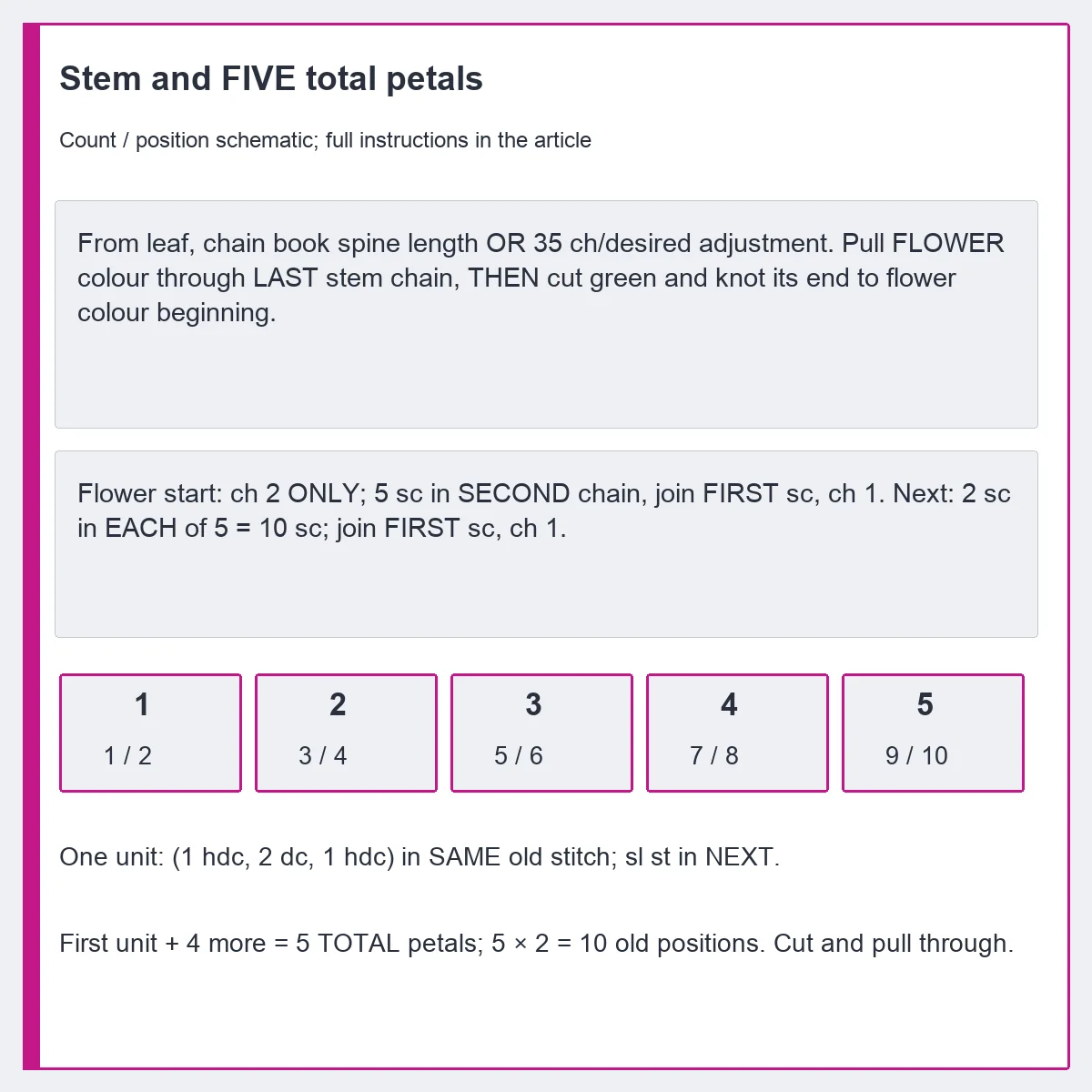
Directly from the leaf, work a chain the length of the book spine. If you do not have a particular book in mind, work 35 ch or adjust the number to your desired length. Pull the flower colour through the last chain of the stem. Cut the green yarn and tie its end to the beginning of the flower colour.
- In the flower colour, ch 2 and work 5 sc in the second chain from the hook. Join with a sl st in the first sc and ch 1.
- Work 2 sc in each of the 5 sc. Join the round with a sl st in the first sc and ch 1. There are 10 sc.
- Work 1 hdc, 2 dc and 1 hdc into the same next stitch. Work 1 sl st in the following stitch. Repeat this sequence 4 more times. You have 5 petals. Cut the yarn and pull it through.
Make the flower centre
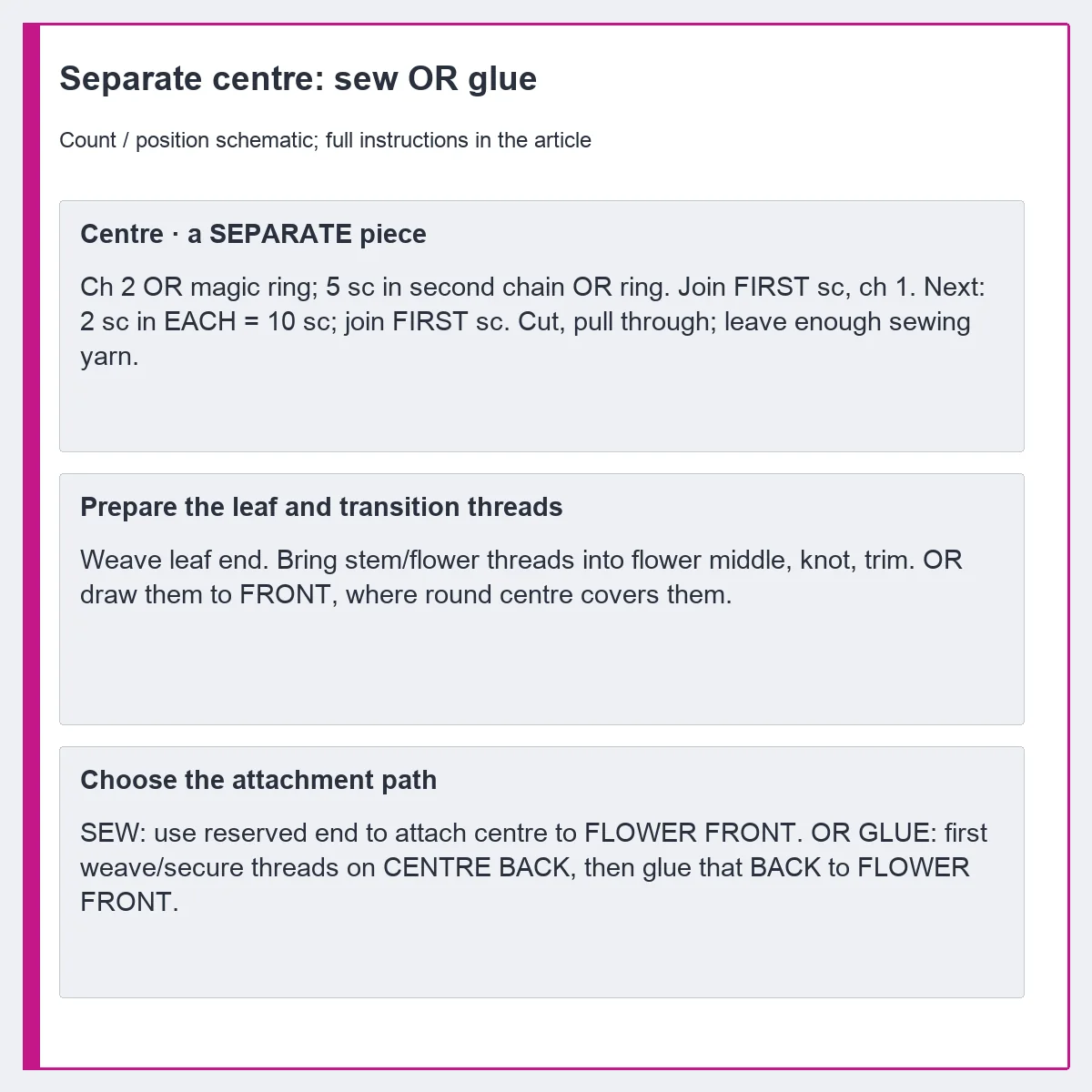
In the centre colour, ch 2 and work 5 sc in the second chain from the hook. You may also work the 5 sc into a magic ring. Join with a sl st in the first sc and ch 1. In the next round, work 2 sc in every sc. Join with a sl st in the first sc. Cut the yarn and pull it through. Leave enough yarn for sewing.
Attach the centre and secure the colour transition
Weave in the end at the leaf. Draw the threads from the transition between stem and flower into the middle of the flower, tie them and trim them. You may also bring them through to the front because the round centre covers them. Sew the centre onto the front with the yarn end left for that purpose.
If you glue the centre, weave in and secure the threads on the back of the centre first. Then glue that back onto the front of the flower.
Map five petals over ten existing positions
The flower starts with two chains and five single crochets in the second chain, followed by the stated join and one chain. The next round doubles the five stitches to ten, then repeats the join and chain. Keep these joined-round actions distinct from a continuous-round habit. A correct five- or ten-stitch total alone would not show whether an unmentioned beginning method or missing join had been substituted.
Each petal unit uses two old positions: one receives half double crochet, two double crochets and half double crochet together; the following receives a slip stitch. Five units consume the ten positions. The instruction makes the first unit and then repeats it four more times, giving five total petals. It does not ask for the first plus five additional units. Count the old targets along with the visible lobes before cutting the yarn.
The centre is a separate two-round piece
Its start allows two chains or a magic ring, unlike the flower instructions which give the two-chain start. Both centre alternatives lead to five single crochets, then ten in its second round. There is no petal round on this piece. Keep enough yarn for sewing as the source requires. Separating its role and colour in the project note prevents the small disc from being mistaken for another stage of the larger flower base.
Choose the attachment route without mixing its order
The source first deals with the leaf end and the transition threads between stem and flower. Those threads are brought into the flower middle, tied and trimmed, with an allowed alternative of drawing them to the front where the round centre will cover them. For sewing, the reserved centre yarn end attaches that disc to the flower front. The disc is not sewn to the leaf or halfway down the stem.
The glue route has its own preparation: weave in and secure the threads on the back of the centre first, then glue that back to the flower front. Do not treat an unsecured thread bundle as the bonding surface. The source offers this route rather than requiring both sewing and gluing. Keep the selected method clear and let any used adhesive reach its required finished state before the bookmark is handled against pages.
Diagnose the location before changing a count
The leaf's second side seems to start too near its tip
Locate the last half double crochet before the three tip stitches. The return begins opposite that half double crochet, on the other side of the original chain. Working into a tip stitch or into the new stitch tops would change the path. Refind the chain spine rather than adding another return stitch to fill an apparent gap. The written five heights and two base stitches already account for the return.
There appear to be six petals
Check whether the first unit was counted before the four additional repeats. Also identify the slip-stitch positions between units. A raised group and its following slip stitch belong to the same unit, using two old positions. Trace all ten base stitches once. Do not cover an extra unit with the centre disc or pull the flower closed to hide it; establish the correct five-unit construction first.
The bookworm bookmark chain map offers a simpler single-colour page marker with a different chain allocation. Its fixed chain instructions do not replace this flower stem's explicit length choice. The mini granny earring structure is another small project with separate attachment decisions. Explore the pattern collection and the author page for further projects and editorial background.