
 Maya Reed
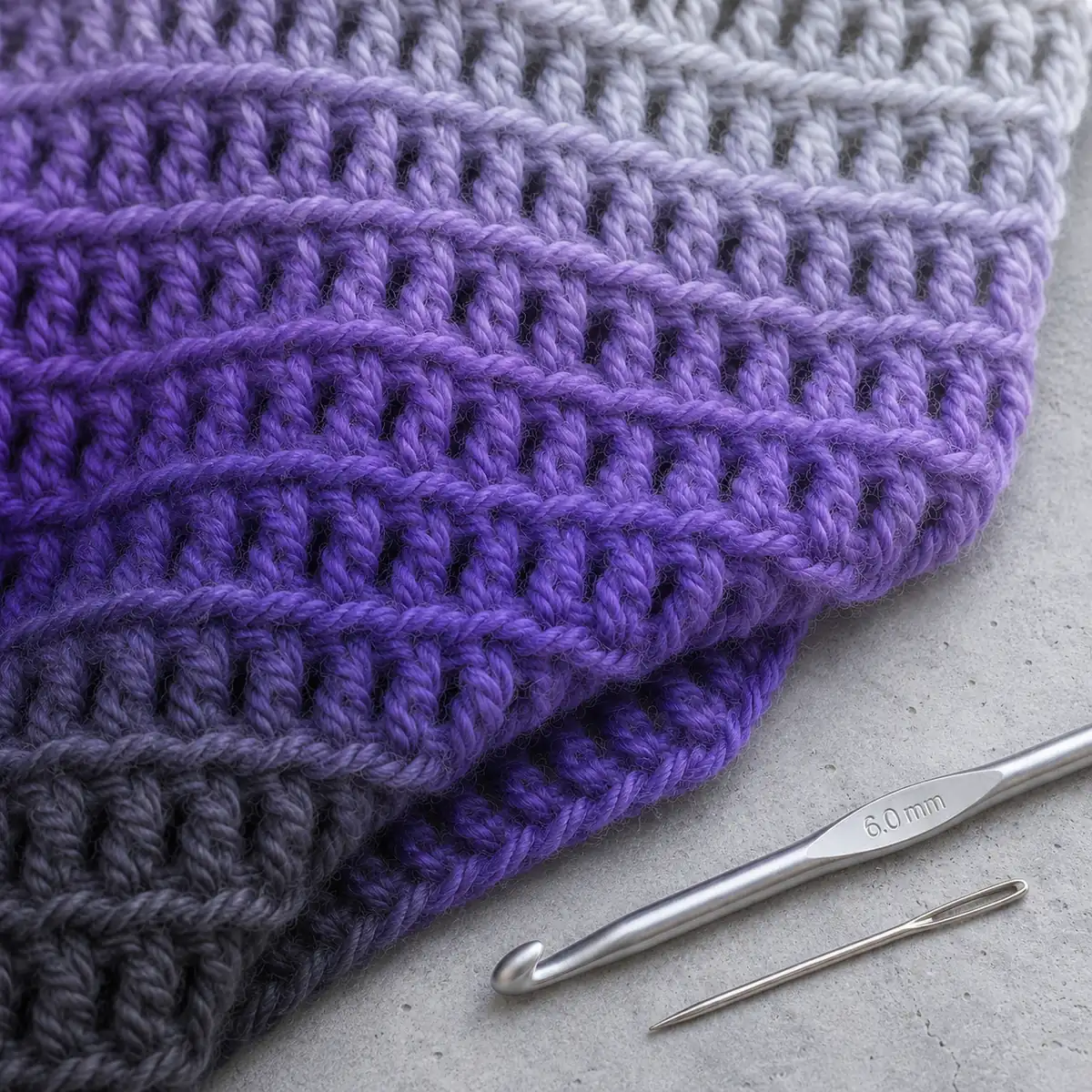
A gradient double crochet blanket has a repeating interior and two edges whose rules are easy to confuse. The foundation's skipped chains do not count as a stitch, while the turning chain in later rows does. That distinction is the technical focus of this version. The source offers a smaller blanket and a sofa blanket, both worked in turned rows with category 5 bulky yarn and a 6 mm hook. Keep the supplied size combinations intact. Their dimensions and gauge are approximate, so a sample provides information without authorising a silent change to the written counts.
Source materials and sizes · Foundation and rows · Gradient direction · Read the edge positions
Keep the material system and size mapping together
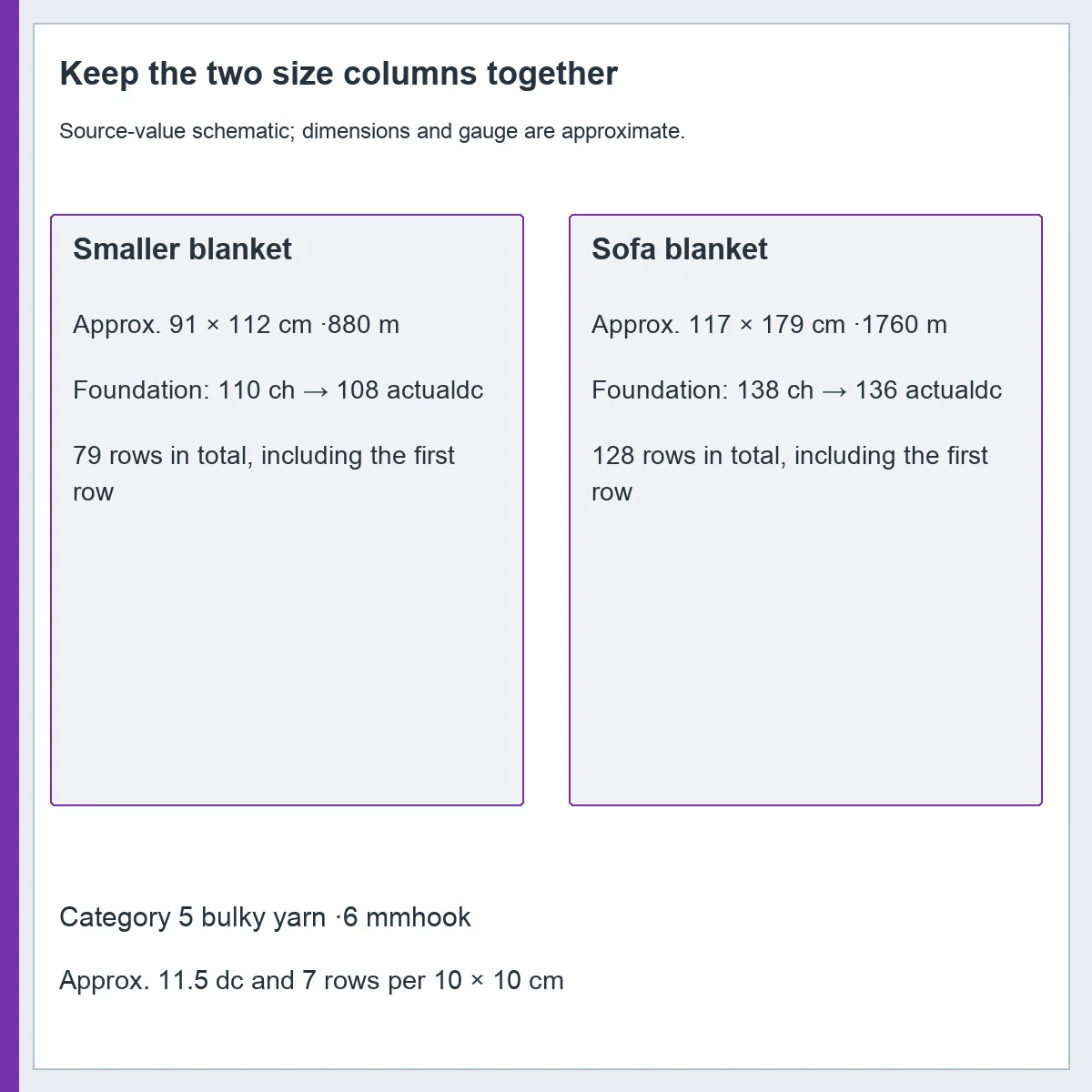
Use category 5 bulky yarn and a 6 mm crochet hook. The source gauge is 11.5 US double crochets and 7 rows over approximately 10 × 10 cm. The finished dimensions below are guidelines, not exact promises derived from the rounded gauge. Keep each size's yarn length, foundation, stitch count and row total together. No yarn brand, fibre, grams or completion time is given. Scissors, a tapestry needle and an edge marker support the stated finishing and edge work.
| Version | Approximate size | Yarn length | Starting chain | Double crochet per row | Total rows |
|---|---|---|---|---|---|
| Smaller blanket | 91 × 112 cm | 880 m | 110 chains | 108 | 79 |
| Sofa blanket | 117 × 179 cm | 1,760 m | 138 chains | 136 | 128 |
The optional project colour family is a dark charcoal-to-violet gradient ending in pale grey. It is a visual choice, not a source product specification. English uses US terms: ch means chain and dc double crochet. A foundation double crochet combines a base link with a completed double crochet. It is an alternative beginning, not an extra row after the chain foundation. The source's two ways of starting and its later turning-chain convention remain separate below.
Compare what the foundation consumes with what the row counts
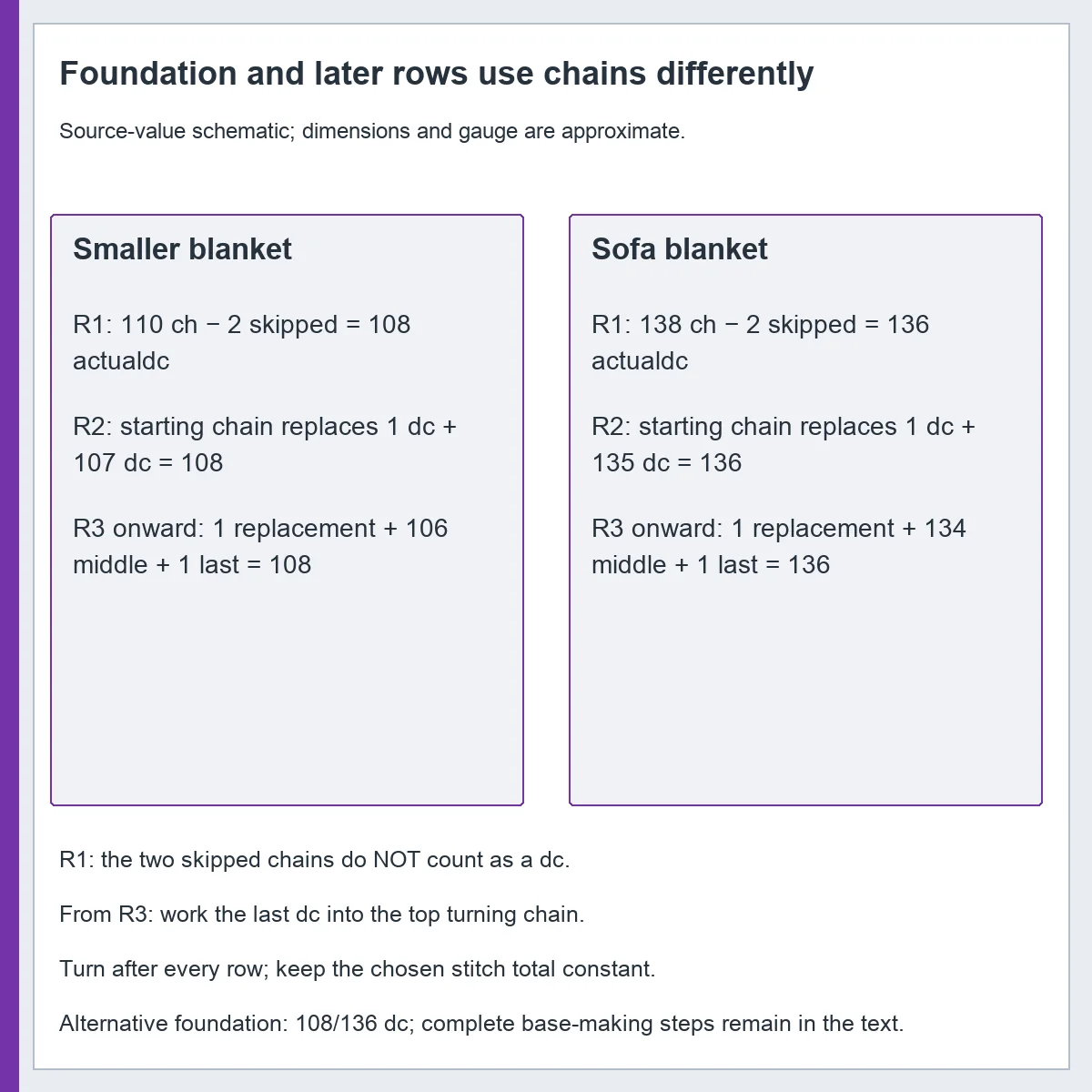
The ordinary foundation begins with more chains than the number of double crochets worked into it. The two chains skipped before the first insertion are expressly excluded from the foundation-row stitch count. This is a source-specific convention. Do not import a familiar rule that counts them as another double crochet. A foundation can appear visually familiar while using a different counting system. Identify the first actual worked stitch, then count the completed double crochets across the row under the size selected in the table.
In the following row, the beginning chain has another role: it represents a stitch. The first actual stitch at its base is skipped because its counted place has already been supplied by the turning chain. Working into that base as well would create an extra counted position. This is not a contradiction with the foundation's skipped chains. The two instructions concern different construction stages. Label the stage when taking notes so that an instruction which is correct for the first row does not become an incorrect habit at every subsequent edge.
The alternative foundation has its own base-making step
The foundation-double-crochet option should be understood as a linked sequence of bases and posts. Its one-loop draw-through creates the new base before the two ordinary double-crochet pull-throughs finish the post. For the next repeat, the insertion belongs in that newly created base. It is not placed into a chain from a separate starting chain waiting underneath. Read this option completely before selecting it. Both source beginnings establish the same actual stitch count for the chosen size, but their actions should not be combined into one longer foundation.
A practice piece can help identify the base link if the movement is unfamiliar. Keep that exercise separate from the actual blanket row and label it as practice. Do not infer a different blanket length or quantity from a small test. The source's material lengths remain the source estimates for its two versions. No numerical conversion to weight is justified without a specified yarn product. A laboratory-style record should preserve what is known, identify what has been measured and leave unspecified information genuinely unspecified.
Work the foundation and the first row
Chain 110 for the smaller blanket or 138 for the sofa blanket. Starting in the third chain from the hook, work 1 dc in every chain. The two skipped chains do not count as a dc in this foundation row. Turn after working 108 dc for the smaller version or 136 dc for the sofa version.
Alternative: foundation double crochet
Alternatively, work the same number of foundation double crochet stitches: 108 for the smaller blanket or 136 for the sofa blanket. Begin with ch 3, yarn over and draw up the yarn through the third chain from the hook. First draw the yarn through one loop to form the foundation link. Then complete the dc by drawing through two loops twice. For the next dc, yarn over and insert into the new foundation link.
Repeat the row while keeping the count constant
Chain 3 to replace the first dc of the new row. Skip the first stitch at the base of that chain and work 1 dc in every remaining stitch. From the third row onward, work the final dc into the top turning chain of the previous row. Turn after every row and keep the stitch count constant.
Repeat this row through row 79 for the smaller blanket or row 128 for the sofa blanket, inclusive. An edge marker helps you find the top turning chain when you work back towards it.
Arrange the gradient symmetrically
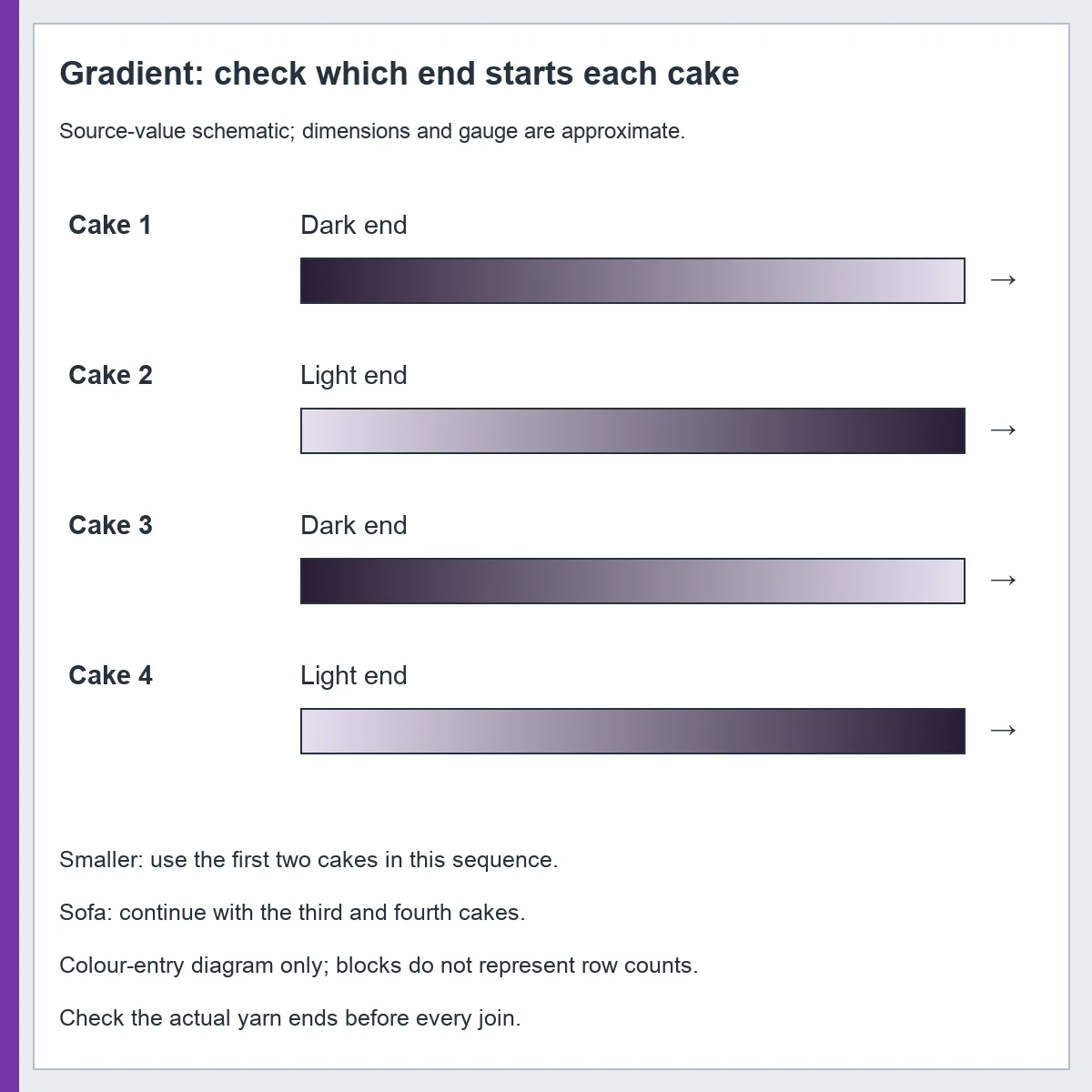
Begin the first cake at its dark end. Join the second cake at its light end so that the gradient reverses and ends dark again. For the sofa blanket, begin the third cake at its dark end and the fourth at its light end. Before every change, check which ends match in colour.
After the final row, cut the yarn, draw it through the loop and weave in the ends. Block the blanket flat if needed.
Trace the two edges as different landmarks
The second row is not another foundation row
Count the turning chain as its stated replacement stitch, then the actual double crochets that follow. The foundation row's two excluded chains do not become another counted edge stitch retroactively. The later instruction to work the last double crochet into a previous turning-chain top begins from the third row onward. Retain that timing. Applying it too early or ignoring it later changes how the edge is interpreted. A clear diagram should label the row number beside the endpoint instead of showing one universal edge symbol for every stage.
When examining a sample, find the active row's beginning chain and follow it to its base. At the far edge, identify whether the named endpoint is an actual stitch or the top turning chain required at that stage. A yarn tail can resemble an extra loop, especially where a cake has been joined nearby. Trace the yarn path rather than selecting the most visible opening. An attractive straight-looking edge alone cannot establish that its counted positions match the source; the actual insertion route matters too.
A falling count calls for an edge check first
If a later row has fewer counted positions, look for an omitted final insertion before assuming that the interior repeat needs an increase. The interior consists of the same stitch, so a missing edge position can accumulate into a noticeable outline change. Do not add compensating double crochets at random in the next row to recover a total. Locate the original omission and return to it. A corrected total distributed through the wrong fabric would still be a changed construction. Keep the size's selected count visible during this inspection.
For a growing count, examine whether a stitch was added at the base of a replacement turning chain. Counting the chain as one and also working an extra stitch there defeats the stated skip. Compare a complete row rather than treating the two edges independently of the total. The source balances its counted beginning with its endpoint rule.
Separate colour-entry direction from stitch direction
The blanket turns after every row. The dark or light entry chosen for a new cake is a different direction decision: it concerns which yarn end begins the next section. Turning the fabric does not reverse the colour order inside a cake. Keep the source's dark/light sequence with the correct version, including the sofa version's third and fourth entries. Examine the actual ends before connecting them. A product's visible outside colour does not identify every colour section or prove that different cakes have exactly matching lengths.
The approximate source gauge and dimensions should also remain distinct from a measured sample. Rounded information can describe a useful target without giving exact arithmetic agreement at every edge. Do not rewrite a foundation or row total to make a calculation look tidier. Record your result and material system separately. If an exact personal target requires a new size plan, identify that as a new calculation rather than calling the source unchanged. The two original size mappings remain intact in the instructions here.
Use a smaller construction for a focused comparison
The classic granny fabric study offers a different way to count grouped stitches, while the eyelet stripe count study separates posts from spaces. They are comparisons, not alternative blanket rows. Choose further work from the pattern collection and read the author page for the editorial approach. Keep each source, measured observation and later experiment identifiable in your own notes.